Monday, 6 February 2012

Middle Class?? Shoo! Scram!!

For all the troubles that befall you, Shani (Saturn) is the sole reason” - a Kannada proverb. Rather sarcastic.

I’m reminded of this every time some public intellectual makes the middle class an object of ire and derision. While the fact that all roads of power in India currently lead to Rome (a Roman to be precise) is left untouched by many of our public intellectuals, they are convinced all the vices that plague the country must compulsively lead to the middle class.

Aakar Patel, in a contrarian piece (linked here) attempts a sterling defense of Manmohan Singh and talks down to the ‘shallow’ middle class. He says South Delhi rejected Manmohan Singh in 1999 and justifies Mr.Singh not bothering to come in through the Lok Sabha later. The intellectual has no popular appeal in India, he laments while evoking an analogy that Dr.Ambedkar lost elections from Mumbai in 1952.

You read that right. Manmohan Singh : Dr.Ambedkar.
Let’s see how none in their well informed mind should take recourse to such a frivolous analogy.

When Dr.Ambedkar fought elections, he took on the might of an establishment led by Jawaharlal Nehru. Mr.Nehru and his party were credited for winning us Independence just 5 years earlier, a watershed moment. Apart from being portrayed as a stalwart of the freedom struggle, Mr.Nehru had also been selected as protégé by a certain M.K.Gandhi, whose name still evokes reverence across the spectrum of classes. Amidst all this there were talks of the full might of the Governmental machinery being used to defeat Dr.Ambedkar. We all know what that means, don’t we? With such factors staring him in the face Dr.Ambedkar was always asking for the moon.
There is widespread doubt if we have a Prime Minister at all in the past few years. So let me remind, Mr.Singh was the incumbent Prime Minister in the 2009 elections. He was hailed to a crescendo as the man who ushered in reforms that set the stage for the middle class to take the world on. It shows the poor political courage of Mr.Singh that the man who had just been Prime Minister and had the whole establishment on his side,  still did not seek a popular mandate for himself. Comparing Manmohan Singh with Dr.Ambedkar is a no-show. Period.

It is true that the intellectual animal is not always the middle class darling. That’s mostly because elitist holier-than-thou mumbo jumbo usually passes off as intellectualism in India, and often puts the middle class off. Despite all this, Aakar Patel offers us an option to agree with Khushwant Singh that Manmohan Singh is the best Prime Minister or be called shallow. Thanks, but no thanks. Depth is not my cup of tea.

Meanwhile, along comes Sagarika Ghose with liberal democrat airs and unleashes a diatribe on “middle class India for being a drag”, calling out their “army-worshipping, democracy-hating, yearning for machismo, abusing independent women”. Now do not ask for proof. That’s as nonexistent as sanity in TV debates.
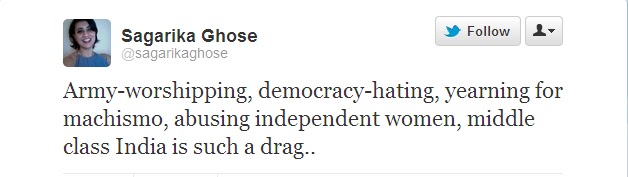


In the wake of the Army Chief vs Government controversy, in a condescending tone, she said notions of ‘honour’ are common in patriarchal feudal societies. She took potshots at the Army Chief alluding that his ‘fight for honour’ as it has been hyped, stems from his feudal patriarchal tendencies. Icing on the cake - she likened the almost failed state of Pakistan to India in this. I now appreciate why it is not often that accusations of high intellect are leveled at her.

Many vented their opinions about her rather profound analysis in both sensible and colourful ways typical of twitter. That Ms.Ghose’s rants here are crass generalizations is a given. But it would be very naïve to imagine it was just that.

Having never seen middle class life, she fails to understand that the most admired quality among the middle class, is sacrifice. Most of them have seen parents, siblings and close family make sacrifices to get them where they are. It is obvious that the middle class deems the Army, which is the simplest example of sacrifice, as admirable. But Ms.Ghose’s mathematics teacher taught her that, admiring the Army = worshipping the Army = Hating Democracy. The great Srinivasa Ramanujan would be proud of that.

Doing some investigative journalism on why the Government may want the Army Chief out is pretty easy. The more intellectually challenging and onerous task is making generalizations against the middle class. And no prizes for guessing Ms.Ghose took the tougher route.

The defense of the Army Chief by some was enough for her to pronounce the middle class machismo-yearning and that the middle class as a practice, hold your breath, abuses independent women (like herself obviously). She resorted to the same ‘I am being targeted because I am a woman’ ploy when she was treated to a heap of criticism at her purely accidental look-live sham involving Sri Sri Ravishankar. Excellent improvement, considering that she has added ‘independent’ to ‘woman’ this time.

With the advent of social media, the distance between the elite powerful class like Ms.Ghose and the middle class that logs into a website at office is just a few keystrokes. It is no longer easy to hoodwink anyone and get away scot free. The middle class’ easy access to her and to facts, has resulted in her bluff being called every now and then. That the people who must be worrying about home loans are actually asking her uncomfortable questions makes her squirm in her seat. And that is her true grouse.

Ms.Ghose obviously doesn’t realize there are the goods, bads and the uglies strewn across the spectrum of classes and the middle class is no exception to it. Being insecure about the middle class growing up and breaking shackles or labeling it for having opinions of its own is an exercise in denial.

Having listened to Aakar Patel, Sagarika Ghose and some other such leading lights I am convinced that the middle class is the biggest threat to democracy and world peace at large. So push them middle class low lives to concentration camps pronto and bang!, all the nation’s problems are solved. Easy peasy…

This piece has appeared on Centre-Right India - centreright.in and can be found here.

Sunday, 1 January 2012

The Intellectual, the Publisher and me.

Despite my rather young age as a 20 something back in the 2000s, the best times I had were with a 50+ year old Publisher Uncle who lived across the street and a 60+ year old Intellectual Uncle next door. Whether it had anything to do with my being a rolling stone lost in thoughts and books, or it had something to do with other people of my age being too engrossed in reality shows, super bikes, swanky cars, international pop-stars and most importantly the opposite sex, I do not know.

Intellectual Uncle was a retired, unmarried IAS officer who had served in high posts in various capacities. The only ambidextrous person I knew. A treasure trove of anecdotes, he was a great raconteur who seemed to have an unconventional take on the political and historical events that shaped our nation. For instance, he had a hilarious take on how Mr.Devegowda became PM. The Janata Party was thinking about the right candidate to choose for PM. As is his wont, he was catching up on his dose of doze. Noticing that his dhoti was slipping away, he got up to adjust it. Fortuitously for himself (only!) when he stood up the question was being thrown around for volunteers to the most coveted post. Lo! He was chosen.  I often pestered Intellectual Uncle to write a book comprising all his anecdotes, only for him to shoo me off with a dismissive wave of his swarthy hands and his mumbles which contained ‘defamation, vendetta, mad, peace, dirty politics’.

Publisher Uncle as his name suggests, was a highly successful publisher of books. He had all the most popular authors on his side for a couple of decades now. That he had an excellent taste for literature was almost a foregone conclusion. He had a keen sense of politics and cricket. And the biggest home-library I have ever seen in my life belonged to him. Intellectual Uncle could be found there almost always.
For years, the three of us sat down in Publisher Uncle’s library, with finely brewed filter coffee or fine whisky (of which Intellectual Uncle was a connoisseur). It was intellectual nirvana. No topic in the world was left untouched. But invariably, the one thing that wove our strands of thought together was our passion for literature. Hence, all our conversations would go hither and thither before turning back to books and litterateurs. Although I would like to think I was endowed with the proverbial pen since birth, it is undeniable that those conversations were the most deciding factor in shaping my thought and my current occupation – an exponent of the written word.

Intellectual Uncle, was a sort of an open book. From the sexcapades of his younger days, to the predicaments of his old age, nothing was taboo.  He would often bring the personal angle to most of what he spoke. Publisher Uncle on the other hand, was extremely secretive, impersonal and an enigma of sorts, whose soul you knew you could not fathom.
Some of the most interesting and fulfilling conversations we had were about a hugely successful author of those days. He wrote all of four books. All bestsellers. He wrote under a pseudonym – Savyasachi Krishna. He remains, to this day, my favourite. I haven’t seen anyone else who could write a subalternist version of the Mahabharata narrated by Karna in which Karna is eventually crowned, follow it up with a huge treatise on the political machinations behind many important events of India from Nehru’s times till the early nineties, then write a book on a Pharaoh in ancient Egypt and finally round them all off with a Sherlock Holmes style thrill-a-minute detective novel based in the USA. Four books of themes from almost different worlds. The sheer versatility, the way the author communicated with readers at various levels, the clairvoyance of a seer and the witty ironies woven into the daily lives of characters in all these books were a total standout. What I loved most about his books were the women. Intelligent, exciting, strong yet grounded.

Publisher Uncle was the publisher for Savyasachi Krishna. He said even he didn’t know the identity of the author, apart from the fact that it was a man, and an Indian. I refused to believe that Publisher Uncle did not know him although I did not make that known to him. He thought Savyasachi was an excellent author, among the best he had read, but used to have a few specific criticisms of him.

Intellectual Uncle was full of criticisms about Savyasachi, always presenting many parallel views to what Savyasachi had deduced at various occasions in his books. I used to have impassioned debates about this with Intellectual Uncle, moderated unofficially by Publisher Uncle. Some debates even bordered on the rancorous given my irrational hate for any criticism leveled at my favourite author. But I could see that every alternate view Intellectual Uncle propounded was a valid one and could be a perfect fit for stories to metamorphose, different from how Savyasachi had shaped them.

We had one such discussion, sipped some scotch and retired for the night.

The next morning I woke up to the news that Intellectual Uncle had passed away due to a massive heart attack while sleeping. Shocked as I was, I called Publisher Uncle to inform. It was news to him too. Intellectual Uncle looked peaceful in his eternal sleep, the serenity of a man who had seen, loved, lived and deciphered all that he surveyed.
Drowned in my reminiscences of this favourite companion of mine, I stood there expressionless. Publisher Uncle came close and whispered,  "I know it appears a strange question to you, but what were the most striking physical features of this man?"
"His unusually dark complexion and his ambidexterity", I replied.
"Which was his favourite language?", Publisher Uncle questioned further.
"Sanskrit", said I.
"Connect your answers", he said.

Tears started flowing involuntarily as I managed to figure out – Savyasachi Krishna!

Wednesday, 21 December 2011

Bhagavad Gita as the 'National Book'?

This piece of mine has appeared in CRI. It has been reproduced here with their consent. Not to be reproduced anywhere else without the same.

The Bhagavad-Gita is a true scripture of the human race a living creation rather than a book, with a new message for every age and a new meaning for every civilization.Sri Aurobindo

Let’s be clear at the very outset that this piece arises from a premise that India/Bharata/Hindustan is an intrinsically a civilization whose roots are in Indic traditions and essentially should be a Rashtra  where its citizens are guided by the essence, ethos and ethics espoused by Indic philosophies.

Sri Krishna himself, in what is among the best creations of a mind ever – the Bhagavad-Gita, eschews from making exclusivist claims about the best path to tread and instead relates the various paths that can be tread to perfect oneself – Bhakti Yoga, Karma Yoga, Jnana Yoga, Sankhya Yoga etc.


For me personally, the Sankhya Yoga, especially the part where Sri Krishna obliges Arjuna’s request to narrate the nature of the ‘SthitaPrajna – The Equanimous’, represents the pinnacle of all our civilization and its thought. My father, on the other hand, thinks that the Karma Yoga represents the ideal way to live. Then again, there is an elderly uncle, who thinks the Thirukkural is wisdom extraordinaire, above all else. My erstwhile landlord, an ardent follower of Basavanna, thinks that the Vachanas are a man’s best friend, philosopher and guide through all the crests and troughs of life.

Likewise there are many who would swear by the Vedas, the Upanishads, the Ramayana, the Mahabharata-as-a-whole and many other such creations of exalted minds, as the ultimate. Shakti-worshippers, Shaivites and other such schools of thought would probably subscribe to a different world-view which is also essentially Indic.

If naming the Bhagavad-Gita our ‘National Book’ is a way to show the nation is proud of such a gem, are we not equally proud of other creations of Indic thought?

If having a ‘National Book’ is about having a philosophical benchmark that the citizens and the State have to strive for, then why just the Bhagavad-Gita?

Superficially speaking, one may be able to portray that some of these varied schools of thought are mutually exclusive of, or better than others. The Bhagavad-Gita looks better and representative of our civilization to someone because that suits the conditioning of their mind. Ultimately all these are products of the same civilization and the same higher levels of intense thought. They are intertwined and derive from each other.

The wonder that is called Sanatana Dharma, thrives despite endless efforts from various quarters at finishing it, because it has not been built around a rigid framework of assertions pushed top-down from a central authority. It is a loose framework of schools of thought that have sprung up from a bottomless well of philosophical constructs which, at their core, have maintained the essentially Indic ethos and are not antagonistic or exclusive of each other, despite impassioned claims to that effect. Once we start dishing out the pride of this book or that school of thought over other ones in an institutionalized manner from the top, we are automatically doing a disservice to other branches that are as representative of our civilizational ethos.

How sensible is it to isolate the Bhagavad-Gita from the other strands of philosophy that added to it as well as our national character?

It can be said that the Western mainstream thought, limited in its capabilities of perception has reduced this gigantic banyan tree of Indic philosophies to the concepts of Karma, Re-incarnation and lately, Yoga.

We would be guilty of doing something similar by surrendering to such symbolism as making the Bhagavad-Gita our ‘National Book’ reducing the Indic nation to be represented by only the Bhagavad-Gita, while the reality is that it is one among the many shining jewels in the heavily bejeweled crown that is Bharateeya civilization.

This call to ask for the Bhagavad-Gita to be declared the ‘National Book’, is at best unnecessary as well as ill-informed and at worst harmful.

“Let’s not forget that we weren’t and should never be one-book civilizations.”